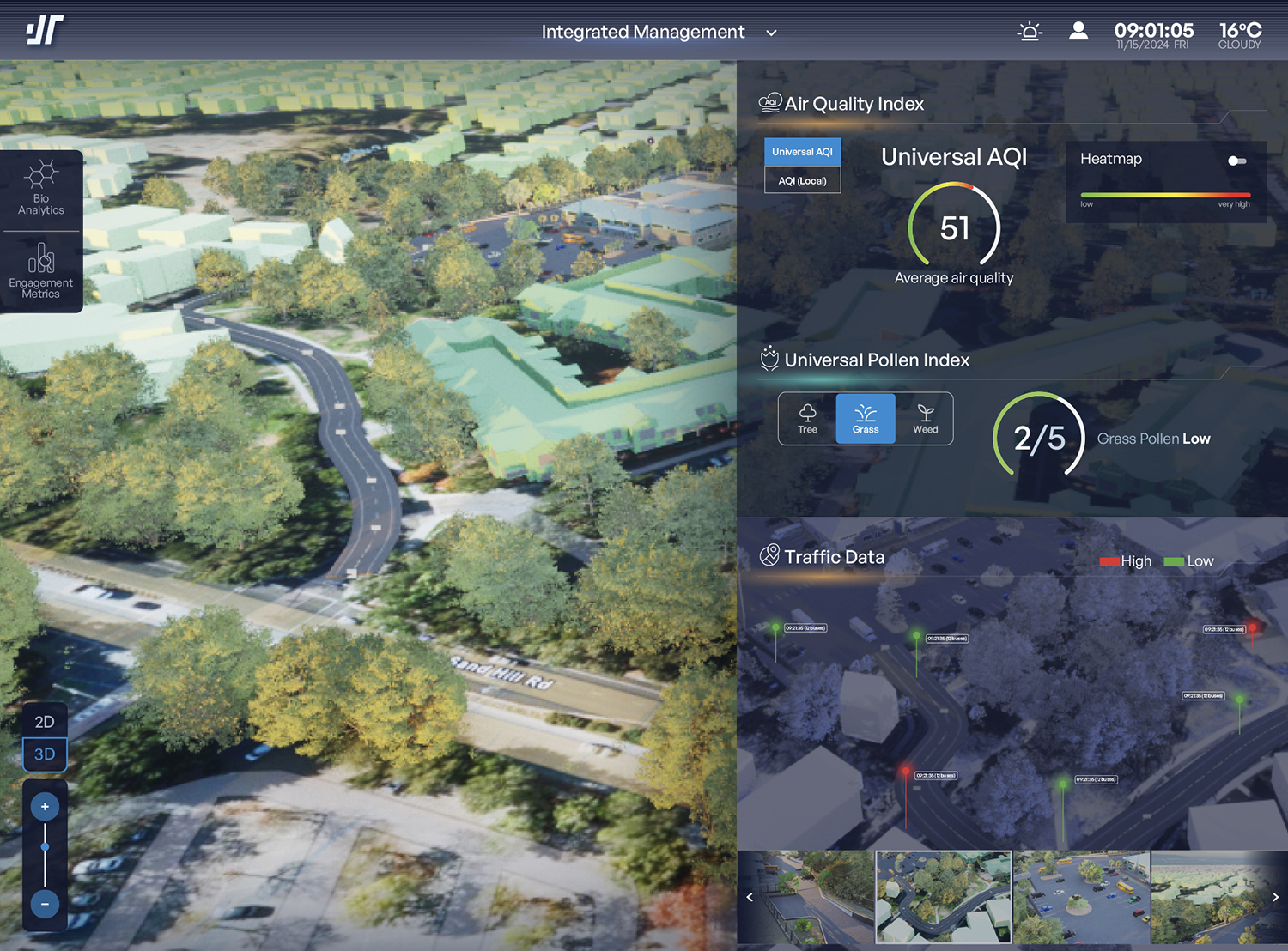
Digital Twins are transforming Smart Cities in profound ways, revolutionizing how we approach urban planning, management, and sustainability.
Imagine having a digital twin of a school—that not only shows the building but also how everything around it works in real time.
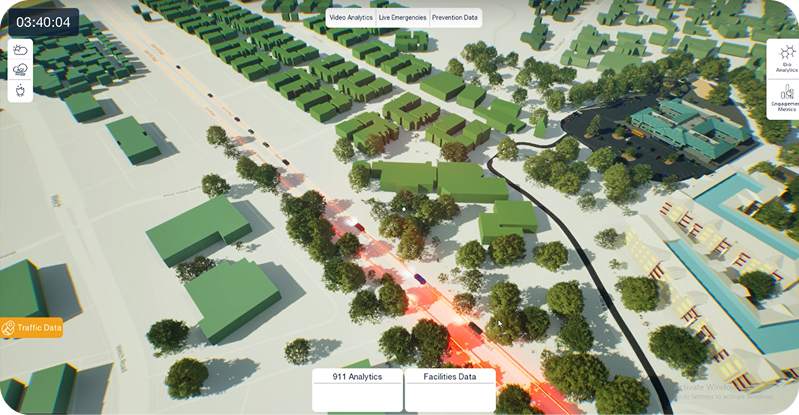
This project is all about creating a lifelike 3D model of the school, blending in live data about the weather, air quality, and even how people and vehicles move around.
As we dive into this project, we’re not just building a model; we’re crafting an experience that brings together the digital and physical worlds.
Project Overview:
- Client: MVP for a school in California and it nearby areas
- Duration: May 2024 – August 2024
- Field: Smart Cities
- Case study (Request for a demo)
Understanding Digital Twins
What is a Digital Twin?
A digital twin is a virtual copy of something in the real world—whether it’s a physical object, a process, or an entire system.
By collecting live data from sensors, simulations, and other sources, digital twins create dynamic, up-to-date models that reflect the physical version.
This connection makes it possible to monitor, analyse and improve how things work in ways that weren’t possible before.
NASA was at the forefront of pioneering simulation technologies in the 1960s, which laid the groundwork for the evolution of the digital twin concept, particularly through its innovative use of simulators during missions like Apollo 13. (Source)
Technology Stack and Communication Channels Used:
Web Technologies
|
Front-end Technologies
|
Importance of Data in Building a Digital Twin
Quality of Data Matters
Good data is the foundation of any digital twin. Without accurate data, the virtual model won’t match reality.
Types of Data Needed:
- Historical data: Past records and information
- Scanned data: 3D scans of physical spaces and objects
- Trained data: Information that helps the system learn and improve
- Data mapping: How different pieces of information connect
Why Data Quality is Key:
- Accurate models need precise measurements
- Real-time updates rely on current data
- Wrong data leads to incorrect predictions
- Better data means more reliable results
Think of it like building a house – you need good materials for a strong foundation.
The same goes for digital twins. The better your data, the more useful your digital twin will be.
FAQ Section:
- What are the 4 types of digital twins?
Component/Parts Twins: The basic building blocks of a digital twin, representing individual components or parts. Asset Twins: When multiple components work together, forming an asset that can be studied and optimized. System/Unit Twins: Showing how different assets come together to form a complete functioning system, enabling visibility into interactions and performance. Process Twins: Providing a macro-level view of how entire systems and processes work together across a production facility or larger operation, helping identify optimization opportunities. The digital twin market is expected to grow rapidly, with projections of it reaching $125.7 billion by 2030, growing at a CAGR of 39.48% from 2021 to 2030. (Source) - Do Digital Twins Use AI?
Yes and no, digital twins use AI to enhance their capabilities. While AI is often integrated into digital twins to enhance their functionality, it is not a mandatory component for all digital twins. AI allows digital twins to analyse sensor data, identify patterns, predict issues, and optimize operations in real-time. By integrating AI, digital twins become dynamic, intelligent models that can drive innovation and improvement across industries like manufacturing, healthcare, and smart cities. - What problem does a digital twin solve?
Digital twins address key challenges in various industries by creating accurate digital models of physical systems. They allow organizations to monitor performance in real time, predict failures, and optimize operations using data insights. By simulating real-world conditions, digital twins improve decision-making, boost efficiency, and lower maintenance costs. They also enable businesses to test new ideas in a virtual space before applying them in reality.
Conclusion
Digital twins are more than just technological advancements; they’re redefining how we interact with and understand our world.
By mirroring the real world in a virtual space, digital twins allow us to test, analyze, and improve systems without the risks and costs associated with real-world modifications.
As this technology continues to evolve, its impact across industries promises to be revolutionary, offering smarter solutions and a deeper understanding of the interconnected systems that make up our daily lives.
We recommend exploring these insightful case studies and resources to deepen your understanding of digital twins:
- IBM Digital Twin Overview: Understand the concept and applications of digital twins across industries. Click here
- McKinsey on Factory Optimization: Discover how digital twins are revolutionizing manufacturing efficiency. Click here
- PwC’s Report on Smart Cities: Learn how digital twins can enhance urban environments, making smart cities more efficient and sustainable through innovative applications. Click here
Leave a Reply